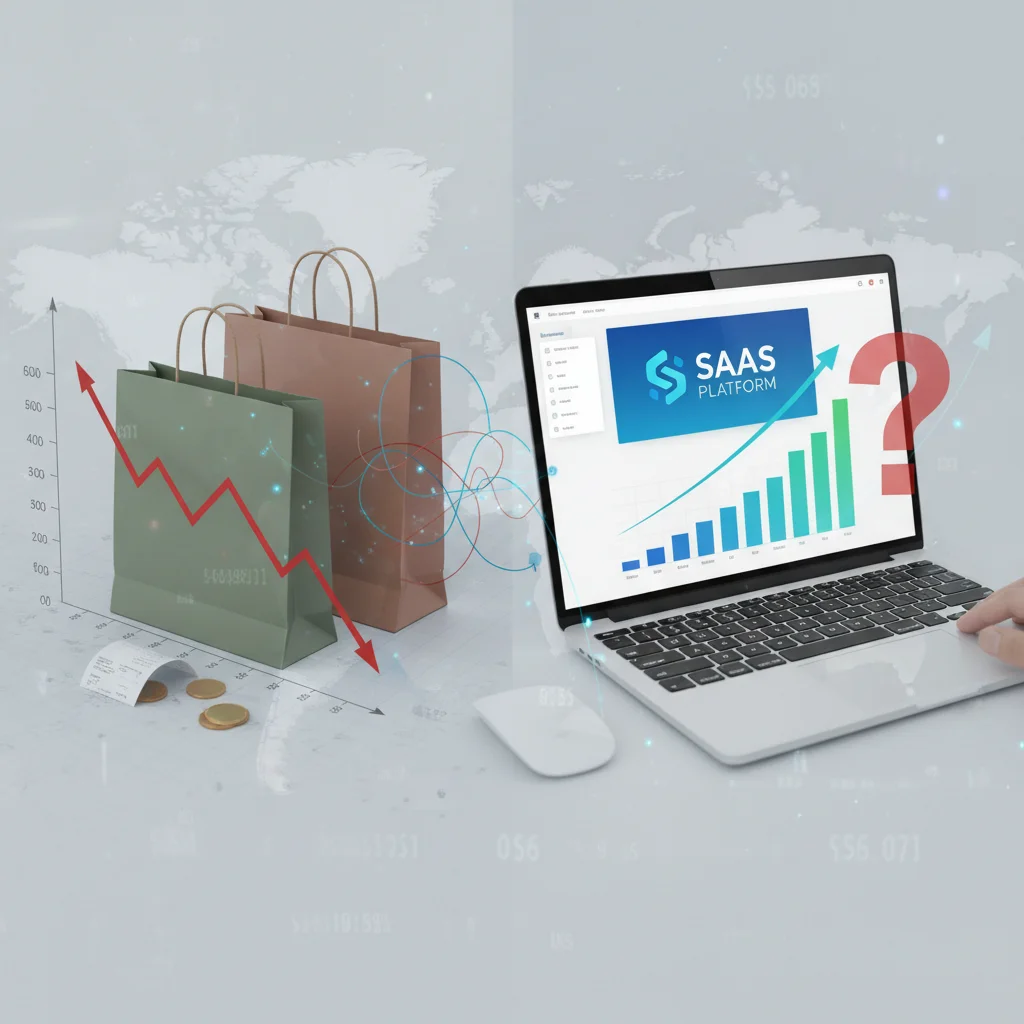
# Retail Sales Data: How Economic Weakness Affects SaaS Demand
The intricate web of the global economy means that shifts in one sector can send ripple effects far and wide, impacting seemingly unrelated industries. In today’s volatile economic climate, characterized by persistent inflation, rising interest rates, and fluctuating consumer confidence, understanding these interconnected dynamics is more crucial than ever. Retail sales data, often seen as a direct pulse of consumer spending and economic health, serves as a critical barometer. When these numbers falter, it signals a broader economic weakness that inevitably reaches beyond storefronts and into the digital realm of Software as a Service (SaaS).
This article will explore how economic weakness, particularly as reflected in retail sales, creates both direct and indirect economic impact SaaS demand. We will delve into the specific mechanisms of this impact, identify which SaaS sectors are most vulnerable, and, crucially, outline strategic approaches for SaaS companies to build resilience. By understanding these dynamics, businesses can better navigate challenging economic landscapes and position themselves for sustained growth.
The Direct Economic Impact on SaaS Demand: When Retail Slows Down
Economic weakness, in the context of retail, manifests as a noticeable decline in consumer spending, lower sales volumes, and often, an accumulation of unsold inventory. This environment forces retailers to tighten their belts, re-evaluate expenditures, and prioritize essential operations over discretionary investments. This immediate financial pressure has a profound direct economic impact SaaS companies serving the retail sector.
Firstly, budget allocation for new software or upgrades becomes significantly constrained. Retailers facing reduced revenue are less likely to invest in new Point-of-Sale (POS) systems, advanced inventory management solutions, sophisticated e-commerce platforms, or cutting-edge customer analytics tools. These are often viewed as significant capital expenditures that can be postponed. Secondly, sales cycles for retail-focused SaaS solutions tend to lengthen considerably. Decision-makers become more cautious, requiring extensive justification for any new spending, leading to prolonged negotiations and delayed purchasing decisions.
Perhaps most critically, existing retail SaaS clients facing financial strain pose an increased churn risk. As noted by industry experts, businesses under pressure often look to cut “non-essential” subscriptions first. For instance, a small boutique struggling with declining foot traffic might cancel its advanced CRM or marketing automation software to save costs. The distinction between ‘must-have’ and ‘nice-to-have’ SaaS becomes starkly clear in a tight economy. Solutions that directly enable core operations or promise immediate, quantifiable cost savings are prioritized, while those offering incremental improvements or long-term strategic benefits may be deprioritized. This direct economic impact SaaS providers feel is immediate and often severe.
Indirect Economic Impact: The Broader Ripple Effect on SaaS Across Industries
The influence of economic weakness, initially signaled by retail sales data, extends far beyond the retail sector itself, creating a broader ripple effect across various industries and impacting diverse SaaS categories. This indirect economic impact SaaS demand is often more pervasive and complex.
When consumer spending declines, it’s not just retailers who suffer. Manufacturers see reduced orders, logistics companies face lower shipping volumes, and marketing agencies experience cuts in advertising budgets. This leads to a general reduction in corporate spending across the board, as companies in all sectors seek to optimize costs and preserve cash flow. Many businesses, regardless of their direct ties to retail, may scrutinize and potentially cut their SaaS subscriptions to achieve these savings.
The vulnerability often differs between B2B SaaS serving Small and Medium-sized Businesses (SMBs) versus large enterprises. SMBs are typically more susceptible to economic shifts due to thinner margins and less diversified revenue streams, making them quicker to cancel SaaS subscriptions. This can lead to a more immediate and widespread economic impact SaaS providers targeting this segment. Furthermore, economic downturns can lead to a tightening of the venture capital landscape, making it harder for SaaS startups to secure funding for growth and innovation, thus impacting the future supply side of the market.
Changes in consumer behavior driven by economic uncertainty also affect other SaaS categories. For example, reduced travel and tourism directly impact hospitality SaaS solutions (e.g., hotel management systems, booking platforms). A slowdown in the housing market can diminish demand for real estate SaaS tools. Beyond tangible financial shifts, there’s a significant psychological impact. Uncertainty breeds caution, leading even financially stable companies to adopt a more conservative spending approach, delaying investments in new technologies.
Navigating the Headwinds: SaaS Strategies for Economic Resilience
While the economic impact SaaS demand can be significant during periods of weakness, adaptable companies can implement strategies to not only survive but potentially thrive. Resilience in this environment hinges on a clear value proposition and strategic agility.
A primary strategy is to relentlessly focus on the value proposition. SaaS companies must emphasize the quantifiable ROI, cost savings, and efficiency gains their solutions provide, rather than just listing features. Demonstrating how a tool can help a client cut expenses or automate processes becomes paramount. Secondly, targeting ‘recession-proof’ or ‘recession-resistant’ industries is a smart move. Sectors like healthcare, essential services, government, and compliance-focused industries often maintain stable spending patterns even during downturns, offering a more reliable customer base.
Optimizing pricing models can also mitigate churn. Offering flexible payment terms, tiered pricing structures, or usage-based models can make solutions more accessible and palatable to budget-conscious clients. Proactive customer retention strategies are critical; enhanced support, regular check-ins, and continuously demonstrating value can significantly reduce churn. As Plante Moran highlights, focusing on existing customer relationships is often more cost-effective than acquiring new ones during tough times.
Product innovation should pivot towards solutions that directly address cost-cutting, automation, and efficiency needs. Tools that help businesses do more with less become invaluable. Diversification, by expanding into new markets or verticals, helps reduce reliance on vulnerable sectors. Finally, financial prudence is non-negotiable. Managing burn rate, extending runway, and efficient resource allocation are crucial for weathering economic storms. As Nasdaq.com often reports, investor sentiment during downturns favors companies with strong balance sheets and clear paths to profitability.
Conclusion: The Future of SaaS in a Volatile Economic Landscape
The insights gleaned from retail sales data and broader economic indicators clearly demonstrate a significant economic impact SaaS demand. When consumers tighten their belts, the ripple effect reaches businesses, prompting them to scrutinize and often reduce their technology spending. This creates both direct challenges for retail-focused SaaS providers and indirect pressures across the entire SaaS ecosystem, affecting everything from SMB budgets to venture capital funding.
However, while challenging, economic shifts also present unique opportunities for adaptable SaaS companies. Those that prioritize a strong, demonstrable value proposition, strategically target resilient industries, and innovate with efficiency in mind are best positioned to navigate these headwinds. The long-term outlook for SaaS remains robust, as digital transformation continues to be a critical component of business operations globally. Yet, the market dynamics will undoubtedly continue to evolve, demanding greater agility, unwavering customer-centricity, and a clear focus on delivering tangible value. In any economic climate, these principles will define sustained success for SaaS businesses.